


Every few months, a new technology promises to solve cybersecurity. AI is the latest, and to be fair, it's earned some of that attention. It detects anomalies faster than human teams, processes threat intelligence at scale, and can simulate phishing scenarios with impressive accuracy. But there's one thing it genuinely can't do: change how people think and act under pressure. Most breaches still trace back to human decisions, and no algorithm fully fixes that.
Key Takeaways
- AI can automate threat detection and generate alerts, but it cannot replace the behavioral change that comes from consistent, repeated human training.
- Attackers frequently combine email, phone calls, and text messages in multi-channel campaigns designed to manipulate employees through coordinated deception.
- Annual or one-time training sessions don't build lasting security habits, because retention requires repeated exposure over time.
- Over-reliance on AI-driven security tools creates blind spots, particularly for low-tech social engineering attacks that don't match existing threat patterns.
- Platforms built around consistent microlearning and human-centered training consistently outperform standalone AI tools in driving real, lasting behavior change.
Why AI Looks Like the Solution
AI tools have genuinely transformed how security teams operate. Automated threat detection, real-time monitoring, and behavioral analytics give organizations visibility that wasn't possible a decade ago. AI can flag a suspicious login attempt before a human analyst even opens their dashboard, and it scales in ways that traditional tools simply can't. For security teams managing hundreds of alerts every day, that kind of automation is a significant advantage.
The problem comes when organizations mistake detection for prevention. Catching a threat after it enters your system is very different from stopping an employee from clicking a malicious link in the first place. That gap is where training lives, and it's a gap that no amount of automated monitoring can close on its own.
Building a Cyber Aware Culture
What AI Actually Can't Do
AI is exceptional at processing data. It's not especially good at changing how people feel about risk. Cybersecurity is as much a behavioral problem as a technical one. Employees who understand why phishing works, who've seen how quickly an attacker can escalate access, and who've practiced recognizing manipulation tactics make genuinely better decisions than those who've only been told not to click suspicious links.
Human behavior change doesn't happen through passive exposure to a threat dashboard. It requires consistent, reinforced learning that people can connect to their actual work environments. That's why platforms built around gamified microlearning lessons tend to outperform one-time security alerts or annual compliance briefings. Short, regular lessons that feel directly relevant build the kind of awareness that actually sticks over time.

Criminals Use a Multi-Pronged Approach
Most cybersecurity awareness training focuses heavily on email. That makes sense, since email remains the most common attack vector. But attackers know that, and they've adapted significantly over the past few years.
One increasingly common tactic is voice phishing, also called vishing. An employee receives an email that appears to come from their IT department. A few hours later, they get a phone call from someone claiming to be tech support, referencing that same email. The two-step approach creates false legitimacy. Because the employee already saw the email, the follow-up call feels like a natural continuation rather than a threat. By the time something feels off, credentials have already been handed over.
Text messages, Teams chats, and LinkedIn messages follow the same logic. Attackers build context and credibility across multiple channels to make manipulation feel routine. Training that focuses only on email leaves employees unprepared for those moments. Understanding human oversight limitations in automated detection tools helps explain why cross-channel human training continues to be a critical part of any security program.
The AI Skills Gap Compounds the Problem
There's a challenge that organizations often overlook. The people responsible for deploying and managing AI security tools frequently don't have the expertise to configure them correctly or interpret what they're seeing. The AI skills gap challenges facing most IT and security teams mean that even strong tools get misconfigured or go underutilized.
That's not a criticism of AI technology. It's a reminder that tools don't eliminate the need for training. Adding AI to your security stack without building the human knowledge to support it adds complexity without actually adding real protection.
Over-Reliance Creates Real Vulnerabilities
When organizations lean too heavily on automated systems, complacency tends to follow. Employees start assuming the AI would have flagged anything dangerous, so they stop questioning suspicious interactions. Security teams reduce manual reviews because the dashboard looks quiet. That comfort is dangerous.
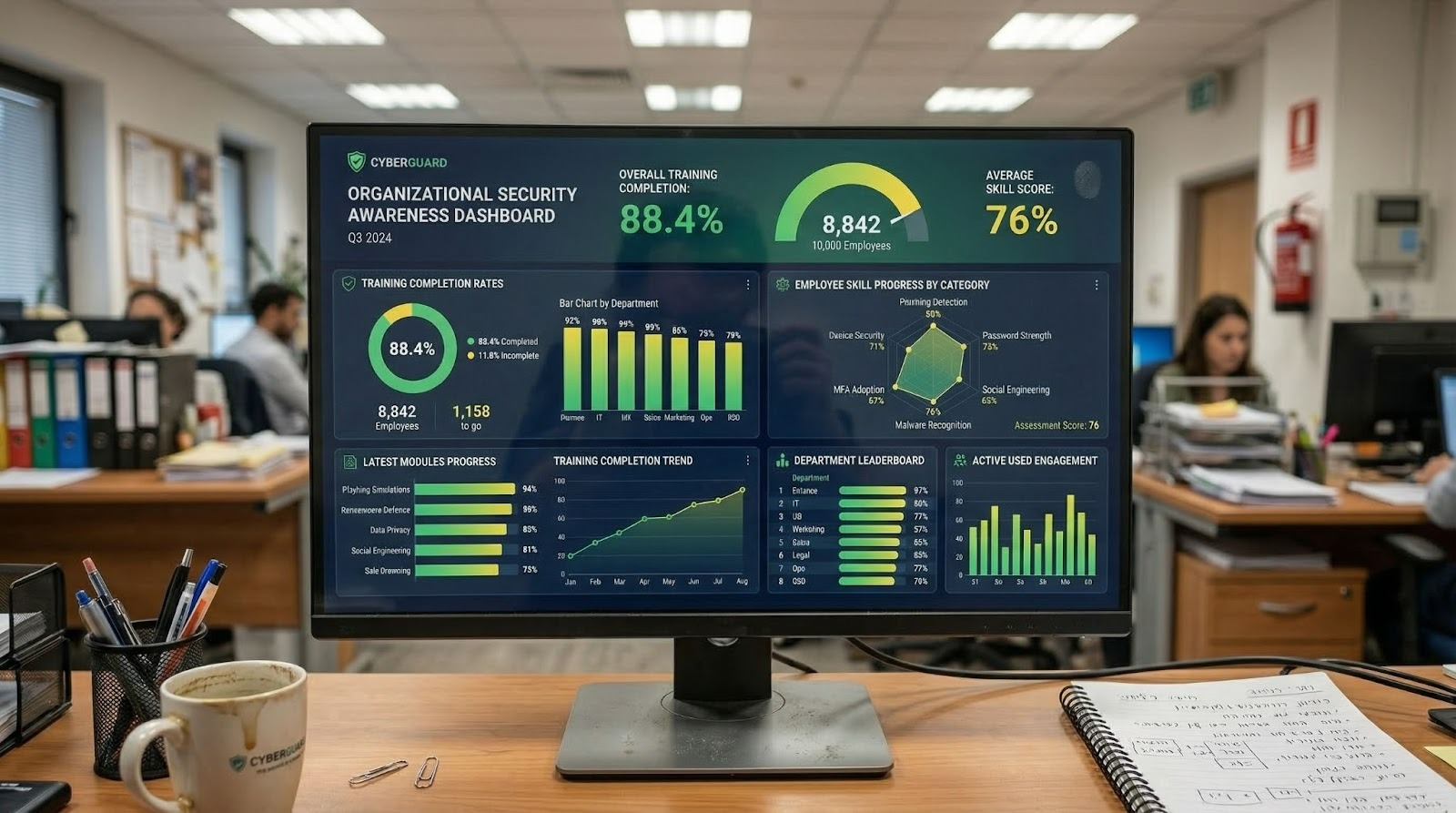
The over-reliance risks in cybersecurity AI are well documented. Automated systems miss low-tech attacks like pretexting calls and manipulated urgency cues. They struggle with novel threats that fall outside existing detection patterns, and they can't account for individual employees who are more susceptible to specific types of manipulation. Using real-time skill tracking gives organizations a clear view of exactly where human vulnerabilities exist, so training can reach the right people at the right time.
Measuring Cybersecurity Program Effectiveness
What Effective Training Actually Looks Like
The most effective cybersecurity programs treat awareness as a continuous process, not a one-time event. They deliver short, regular lessons tied to real scenarios that employees encounter in their specific roles. They track what's working and adjust when it isn't. The goal is consistent exposure over time, not a single training session that employees move on from and quickly forget.
AI absolutely plays a supporting role in this. Personalized learning paths, adaptive content delivery, and behavioral analytics make training more relevant and more efficient. But those tools work because they're built around a human-centered framework, not because AI replaced the human element. The automation supports better training. It doesn't substitute for it.
The goal isn't to choose between AI tools and human training. It's to make your training smarter, more consistent, and built around real behavior change. Start your free trial with Drip7 and see how a platform designed around genuine security awareness can strengthen your team's security culture from the inside out.
Conclusion
AI will keep advancing. Threat detection tools will get faster, more precise, and harder for attackers to outmaneuver. But the human side of security isn't a problem that better algorithms will ever fully solve. People will still get tired, distracted, pressured, and curious. They'll still click things they shouldn't. Keeping them informed, practiced, and genuinely prepared takes consistent, human-centered effort. That's what good training delivers, and it's what no AI system can replicate on its own.